3. Movement into & out of Cells
1. This question has 5 part(s).
1.1. Fig. 1.1 is a diagram of a plant cell.
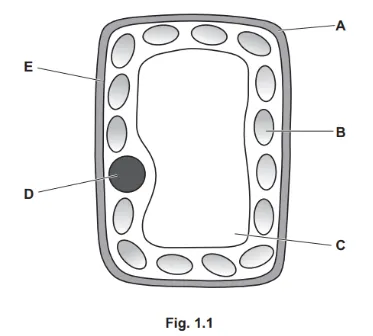
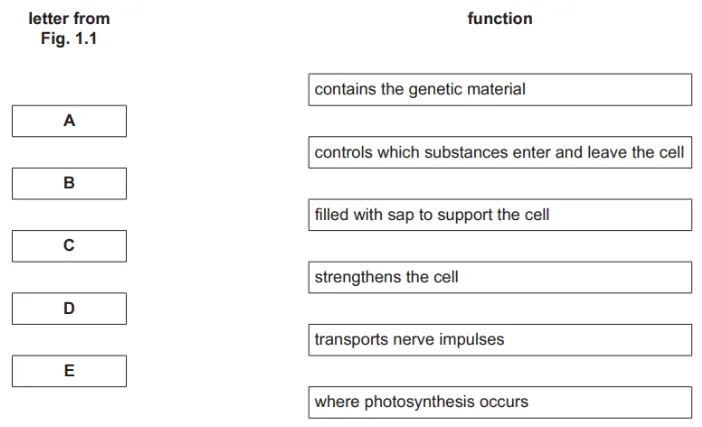
The boxes on the left contain the letters that identify some parts of the plant cell in Fig. 1.1.
The boxes on the right show the functions of some parts of a cell.
Draw five lines to link each letter to its correct function.
1.2. State the names of two different types of plant cell.
1.3. A student used a potato as a source of plant tissue. The student cut six cylinder-shaped pieces from the potato.
Each potato cylinder had the same diameter. Each potato cylinder was immersed in either water or one of five different concentrations of sugar solution.
The student measured the length of the potato cylinders before immersion and after being immersed for 30 minutes.
Table 1.1 shows the results.
Table 1.1
concentration of sugar solution /mol per dm3 | length of potato cylinder before immersion /mm | length of potato cylinder after immersion /mm | change in length of potato cylinder /mm |
|---|---|---|---|
0.0 | 49.5 | 52.0 | + 2.5 |
0.2 | 50.0 | 52.0 | + 2.0 |
0.4 | 50.5 | 51.5 | + 1.0 |
0.6 | 50.5 | 51.0 | + 0.5 |
0.8 | 50.0 | 49.0 | |
1.0 | 50.0 | 48.5 | – 1.5 |
(i) Use the information in Table 1.1 to calculate the change in length of the potato cylinder immersed in the 0.8mol per dm3 sugar solution.
................................................... mm [1]
(ii) Use the information in Table 1.1 to calculate the percentage increase in length of the potato cylinder immersed in the 0.2mol per dm3 sugar solution
. ............................................................ % [2]
1.4. State the name of the process that causes water to enter or leave the potato cells.
1.5. Describe the expected change in appearance of a potato cell that was immersed in a 1.0mol per dm3 sugar solution.

Ai এর মাধ্যমে

১০ লক্ষ+ প্রশ্ন ডাটাবেজ

প্র্যাকটিস এর মাধ্যমে নিজেকে তৈরি করে ফেলো
উত্তর দিবে তোমার বই থেকে ও তোমার মত করে।

সারা দেশের শিক্ষার্থীদের মধ্যে নিজের অবস্থান যাচাই
No related questions found