Genetic Diversity & Adaptation
1. This question has 4 part(s).
1.1. The overuse of antibiotics in recent years has caused a major resistance problem. The number of antibiotic resistant bacterial strains has increased with some bacteria becoming resistant to the action of several antibiotics. A well known example of this is MRSA, a type of Staphylococcus bacteria. MRSA mainly affects hospital patients.
MRSA can live harmlessly on the skin of many people. However, if the bacteria reaches deeper inside the body an infection may develop. Give two reasons why hospital patients are more at risk of developing disease after exposure to MRSA.
1.2. When antibiotics are used to treat bacterial infections, the dosage used is carefully controlled. The minimum inhibitory concentration (MIC) is the lowest concentration of a substance that will inhibit the growth of a microorganism.
When prescribing antibiotics, the recommended dose is always greater than the MIC. Suggest two reasons why.
1.3. Research scientists trialled a new group of drugs to test their effectiveness against four different species of bacteria. The scientists used MICs to compare how effective the four drugs were. The results are shown in Table 1 below.
Table 1
| Minimum inhibitory concentration ( μg cm–3) | |||
Drug | Escherichia coli | Streptococcus pneumoniae | Enterococcus faecalis | Campylobacter enteritis |
A | 0.37 | 0.052 | 0.048 | 3.12 |
B | 1.58 | 0.052 | 0.198 | 3.12 |
C | 0.37 | 0.052 | 0.197 | 1.58 |
D | 1.60 | 0.095 | 0.391 | 12.8 |
State and explain which drug was the most effective against all species of bacteria?
1.4. Some strains of S. aureus are resistant to the antibiotic Penicillin. Scientists grew cultures of S. aureus in a medium containing a low concentration of Penicillin. The concentration of Penicillin that the scientists was able to kill some, but not all, of the bacteria population. At 11am every day, they removed a sample of the bacteria from the culture. The sample was tested to find the concentration of Penicillin that prevented the growth of 50 % of the bacteria in the sample.
The scientists then used the exact same method to investigate the resistance of S.aureus to a new drug, Y. The results of both experiments are shown in Figure 1 below.
Figure 1
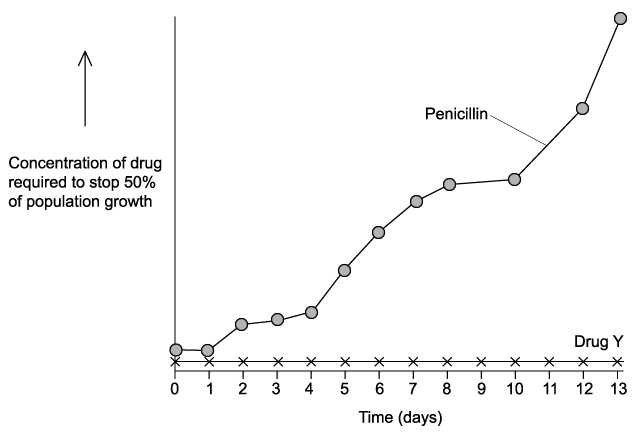
After 30 days all of the bacteria developed resistance against Penicillin but not drug Y.
Explain in terms of natural selection how this resistance has evolved.

Ai এর মাধ্যমে

১০ লক্ষ+ প্রশ্ন ডাটাবেজ

প্র্যাকটিস এর মাধ্যমে নিজেকে তৈরি করে ফেলো
উত্তর দিবে তোমার বই থেকে ও তোমার মত করে।

সারা দেশের শিক্ষার্থীদের মধ্যে নিজের অবস্থান যাচাই
No related questions found