Reaction Rates
1. This question has 4 part(s).
1.1. During the following reaction, A and B react together to produce C.
A + 2B → C
The production of C over time is shown below.
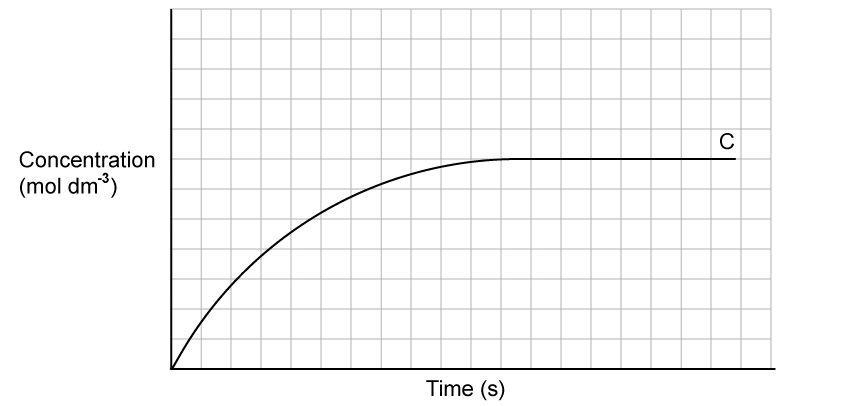
i) Sketch a line on the graph to show what happens to A and B during the progress of the reaction.
[1]
ii) On the graph, write the letter E at the point at which an equilibrium is first established.
[1]
1.2. In the reaction in part (a), lumps of A were used. Use collision theory to explain what would happen to the rate of the reaction if powdered A was used instead of lumps.
1.3. Hydrogen peroxide decomposes more rapidly in the presence of aqueous hydrogen bromide. The decomposition proceeds as shown by the following equations.
H2O2 + HBr → HBrO + H2O
HBrO + H2O2 → H2O + O2 + HBr
Give two reasons, other than an increase in the reaction rate, why these equations suggest that hydrogen bromide is behaving as a catalyst.
1.4. In the Haber Process, nitrogen and hydrogen are reacted together in a sealed container to form ammonia, NH3. Increasing the pressure and adding a catalyst both speed up the rate of this reaction.
i) Write a balanced symbol equation to show this reaction.
[1]
ii) Explain why, using collision theory, increasing the pressure speeds up the rate of the reaction.
[2]
iii) Use a labelled Maxwell-Boltzmann curve to explain how the addition of a catalyst increases the rate of reaction.
[3]

Ai এর মাধ্যমে

১০ লক্ষ+ প্রশ্ন ডাটাবেজ

প্র্যাকটিস এর মাধ্যমে নিজেকে তৈরি করে ফেলো
উত্তর দিবে তোমার বই থেকে ও তোমার মত করে।

সারা দেশের শিক্ষার্থীদের মধ্যে নিজের অবস্থান যাচাই
No related questions found