The Mole & the Avogadro Constant
1. This question has 5 part(s).
1.1. Separate: Chemistry and Extended Only
This question is about the yield of chemical reactions.
In practice, scientists aim for a 100% yield but this is rarely achieved.
Complete the sentences to explain why a 100% yield is not achieved using words from the list.
side reactions | transfer | complete | incomplete |
purification | reversible | irreversible | mixing |
Reactants and products can be left behind during _______________ from one container to another.
_______________ reactions can never have a 100% yield because the products are forming reactants.
A reaction might not go to completion because of _______________ or the presence of an impurity. These reactions are described as _______________ .
1.2. Separate: Chemistry and Extended Only
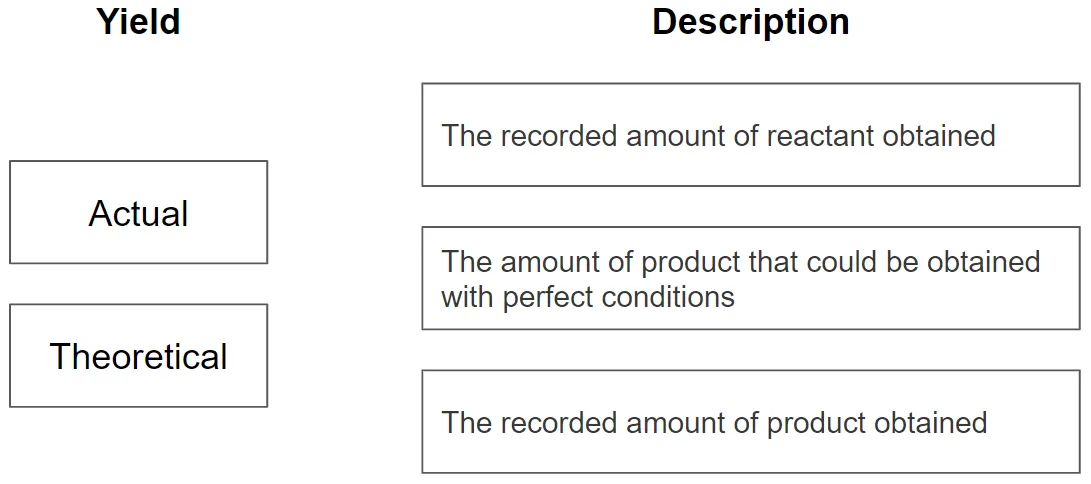
There are different types of yield.
The percentage yield compares the actual yield to the theoretical yield.
Draw one line from each yield to its description.
1.3. Extended Only
A student completed an experiment using magnesium to displace copper from copper(II) sulfate.
Mg + CuSO4 → Cu + MgSO4
The student added 4.8 g of magnesium to a solution of copper(II) sulfate.
Calculate the number of moles of magnesium that the student used.
Relative atomic mass (Ar): Mg = 24
Use the equation:
1.4. Separate: Chemistry and Extended Only
Using your answer to part (c), calculate the theoretical yield of copper.
Relative atomic mass (Ar): Cu = 63.5
Theoretical yield of copper = ________ g
1.5. Separate: Chemistry and Extended Only
Another student completes the same experiment using 4.8 g of magnesium.
They obtain 10.16 g of copper.
What is the percentage yield of this student's experiment?

Ai এর মাধ্যমে

১০ লক্ষ+ প্রশ্ন ডাটাবেজ

প্র্যাকটিস এর মাধ্যমে নিজেকে তৈরি করে ফেলো
উত্তর দিবে তোমার বই থেকে ও তোমার মত করে।

সারা দেশের শিক্ষার্থীদের মধ্যে নিজের অবস্থান যাচাই
Extended Only
Sulphur dioxide reacts with chlorine in an addition reaction to form sulphuryl chloride.
SO2 + Cl2 → SO2Cl2
8.0 g of sulphur dioxide was mixed with 14.2 g of chlorine. The mass of one mole of SO2Cl2 is 135 g. Calculate the mass of sulphuryl chloride formed by this mixture.
Calculate the number of moles of SO2 in the mixture = ..................
Calculate the number of moles of Cl2 in the mixture = ..................
Which reagent was not in excess? ...............................
How many moles of SO2Cl2 were formed = ...................
Calculate the mass of sulphuryl chloride formed = ............. g
Crystals of sodium sulphate-10-water, Na2SO4.10H2O, are prepared by titration.
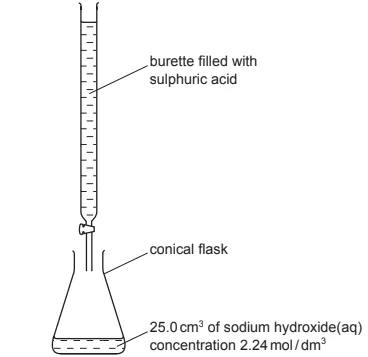
25.0 cm3 of aqueous sodium hydroxide is pipetted into a conical flask. A few drops of an indicator are added. Using a burette, dilute sulphuric acid is slowly added until the indicator just changes colour. The volume of acid needed to neutralise the alkali is noted.
Suggest how you would continue the experiment to obtain pure, dry crystals of sodium sulphate-10-water.
Extended Only
9.12 g of anhydrous iron(II) sulfate was heated. Calculate the mass of iron(III) oxide formed and the volume of sulfur trioxide, at r.t.p., formed.
2FeSO4 (s) → Fe2O3 (s) + SO2 (g) + SO3 (g)
mass of one mole of FeSO4 = 152 g number of moles of FeSO4 used = _____________ number of moles of Fe2O3 formed = _____________ mass of one mole of Fe2O3 = _____________ g mass of iron(III) oxide formed = _____________ g number of moles of SO3 formed = _____________ volume of sulfur trioxide formed = _____________ dm3
This question has 5 part(s).