7. Practical Skills
1. This question has 4 part(s).
1.1. Students investigate how to extract DNA from peas. Stage 1:
Chill 10cm3 of ethanol. Keep it on ice throughout the method for use in stage 2.
Make a thick ‘soup’ by blending 100cm3 of peas with salt and cold water. Blend for 15 seconds in an electric blender.
Strain the ‘soup’ through a mesh strainer and collect the liquid part in a beaker.
Add 30cm3 of washing-up liquid and swirl to mix.
Let the mixture settle for 5–10 minutes in a water bath at 60°C.
One group of students made a water bath using a beaker of water, thermometer and Bunsen burner. Another group used an electric water bath.
Write down two advantages of using an electric water bath.
1 ........................................
2 .........................................
1.2. Low temperatures protect DNA by slowing down the activity of enzymes that destroy DNA. High temperatures break down membranes in the cell.
To extract DNA, some methods use a water bath at 60°C but other methods do not use an increased temperature.
Suggest two reasons for the different methods.
1.3. Stage 2 isolates the DNA.
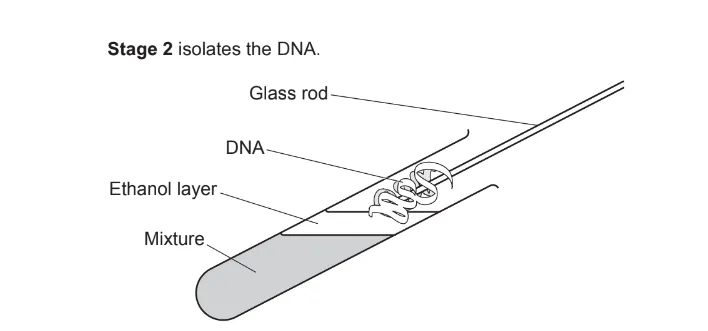
Pour the mixture collected from stage 1 into a test tube until a third full. Add protease enzymes to the test tube.
Slowly pour cold ethanol at an angle of 45° into the tube. Ethanol will float on top.
DNA is soluble in water, but salted DNA does not dissolve in ethanol and will form white clumps where the water and ethanol layers meet.
Twirl a glass rod and the DNA will collect on the rod.
Dry the sample on a pre-weighed filter paper and measure the mass of product.
Suggest two safety precautions which should be taken at stage 2.
Explain why each safety precaution is needed.
1 Safety precaution: ......................................
Explanation: ......................................................
2 Safety precaution: ........................................
Explanation: ........................................................
1.4. Look at the table. It shows the results from the two groups of students in the investigation.
Type of water bath used | Mass of DNA collected (mg) | |||
Test 1 | Test 2 | Test 3 | Mean | |
Beaker of water and Bunsen burner | 22.9 | |||
Electric | 33.6 | 32.3 | 33.3 | .................... |
(i) Calculate the mean mass collected in the investigation using the electric water bath.
Give your answer to 1 decimal place.
Answer = ..................................... mg
[2]
(ii) The range of the three test readings for the beaker of water and Bunsen burner was 3.4.
Does the evidence support using an electric water bath instead of a beaker of water and Bunsen burner?
Explain your answer.
[2]

Ai এর মাধ্যমে

১০ লক্ষ+ প্রশ্ন ডাটাবেজ

প্র্যাকটিস এর মাধ্যমে নিজেকে তৈরি করে ফেলো
উত্তর দিবে তোমার বই থেকে ও তোমার মত করে।

সারা দেশের শিক্ষার্থীদের মধ্যে নিজের অবস্থান যাচাই
No related questions found