Diffraction
1. Diffraction gratings have a wide range of uses in science and medicine.
Which of the following answers contain four correct uses of diffraction gratings?
Use 1 | Use 2 | Use 3 | Use 4 | |
A | Analyse Light from stars | Analyse the absorption spectra in stars | Analyse the signals received in a piezoelectric crystal | Analyse the frequency of sound coming from oceanic mammals |
B | Analyse composition of stars | X-Ray crystallography | Analyse the dust particles of a comet | Measure the wavelength of light from a star |
C | Chemical analysis of stars | Measure the rotational frequency of a star | Measure rotation of a planet | Measure the velocity of a comet travelling towards Earth |
D | Measure red shift | Measure the frequency of light from a star | Analyse the emission spectra in stars | Observe the spectra of materials |

Ai এর মাধ্যমে

১০ লক্ষ+ প্রশ্ন ডাটাবেজ

প্র্যাকটিস এর মাধ্যমে নিজেকে তৈরি করে ফেলো
উত্তর দিবে তোমার বই থেকে ও তোমার মত করে।

সারা দেশের শিক্ষার্থীদের মধ্যে নিজের অবস্থান যাচাই
A discharge lamp emits light of four colours: red ( λ = 665 nm), green ( λ = 550 nm), blue ( λ = 470 nm) and violet ( λ = 400 nm). The diagram shows light from the lamp incident normally on a diffraction grating with 0.8 x 10³ slits per millimeter. The light is viewed through a telescope that can be rotated as shown.
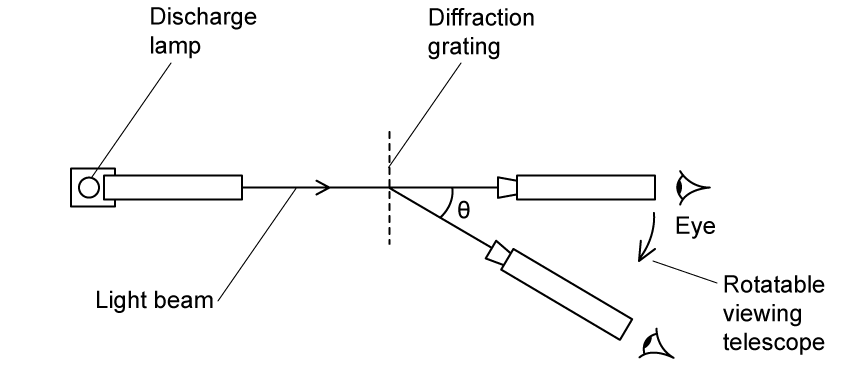
As the telescope is rotated from the straight through position, each of the four colours is observed as a bright line at its corresponding first-order diffraction angle.
How many additional order of maxima will be seen with this set up for the colour that is observed furthest away from the central maxima?
The figure below shows a spectrometer that uses a diffraction grating to split a beam of light into its constituent wavelengths and enables the angles of the diffracted beams to be measured.
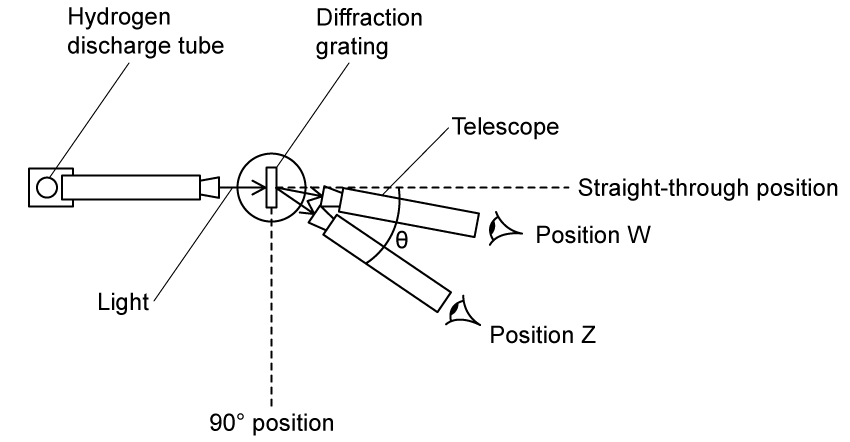
Light with a particular wavelength is passed through the diffraction grating. The angle of diffraction θ at the centre of the first observed beam at Z in the image above is 63.0⁰ and the grating has 1562 lines per mm.
A dark fringe is observed at position W, with the central maximum at the straight-through position.
How many orders of maxima of this light are present at this wavelength?
This question is about the measurement of the wavelength of laser light.
The light is shone onto a diffraction grating at normal incidence.
The light transmitted by the diffraction grating produces five spots on a screen. These spots are labelled P to T as shown in the diagram below.
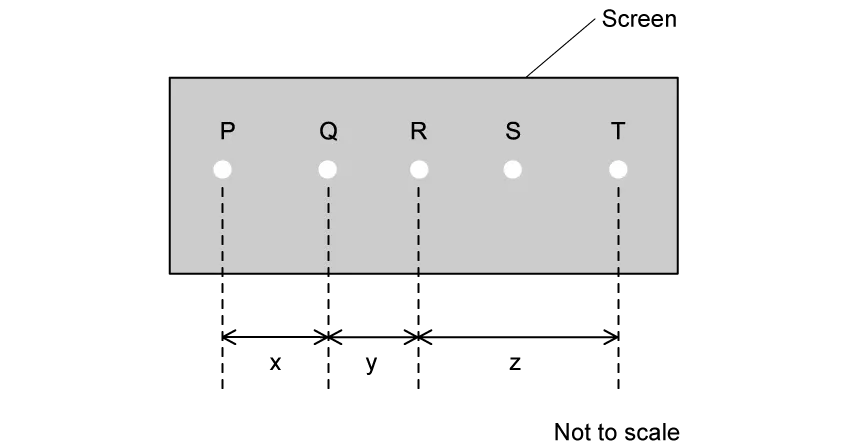
A student uses a meter ruler with 1 mm divisions to take readings. She uses these readings to obtain the measurements x, y and z the distances between centres of the spots.
The table shows her measurements and her estimated uncertainties.
Measurement | Distance / mm | Uncertainty / mm |
x | 289 | 2 |
y | 255 | 2 |
z | 544 | 2 |
The distance between the centres of spots P and R and the distance between the centres of R and T are equal.
That is:
x + y = z
What is the percentage uncertainty in the sum of x and y?
Monochromatic electromagnetic radiation of wavelength 3.2 x 10⁻⁷ m is incident normally on a diffraction grating with 5.0 x 10⁵ lines per meter.
What is the highest order maximum produced?