Nuclear Magnetic Resonance Spectroscopy
1. This question has 4 part(s).
1.1. Four samples containing alcohols were studied by 13C NMR spectroscopy. The alcohols all have the formula C4H10O.
i) Draw the four alcohol isomers of C4H10
ii) For each isomer, deduce the number of chemical peaks expected in the 13C spectrum.
iii) The 13C NMR spectra of one of the isomers is shown below in Figure 1.
Figure 1
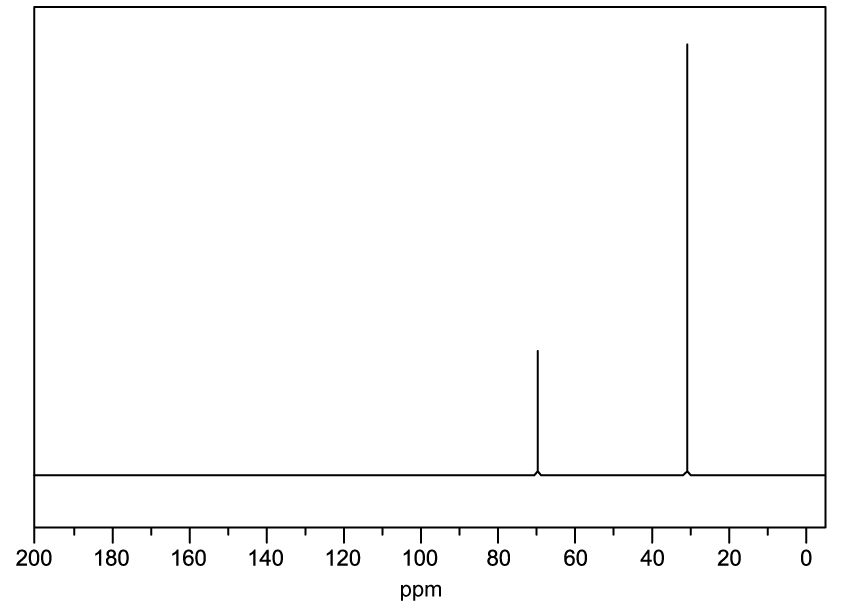
Deduce which of the isomers produced the spectra shown in Figure 1 and explain your answer with reference to the chemical shift pattern.
1.2. State the number of peaks in the proton NMR spectra of CH3CH2CH2CH2OH and of HOOCCH2CH2COOH. Analysis of peak splitting is not required.
1.3. Compound A can be converted into compound B via an intermediate species as shown in Figure 1 below;
Figure 1

Suggest how you would be able to determine the difference between compounds A and B by analysis of their 1H NMR spectra.
1.4. Compound X was studied using 1H NMR spectroscopy. The formula of Compound X is shown in Figure 2.
Figure 2

i) State the number of peaks in the 1H NMR spectrum of X.
ii) State the splitting pattern of the protons labelled with the *.
iii) State the IUPAC name of X.
iv) Identify a solvent in which X can be dissolved in before obtaining its 1H NMR spectrum.

Ai এর মাধ্যমে

১০ লক্ষ+ প্রশ্ন ডাটাবেজ

প্র্যাকটিস এর মাধ্যমে নিজেকে তৈরি করে ফেলো
উত্তর দিবে তোমার বই থেকে ও তোমার মত করে।

সারা দেশের শিক্ষার্থীদের মধ্যে নিজের অবস্থান যাচাই
No related questions found