States of matter
1. This question has 2 part(s).
1.1. Separate: Chemistry Only
This question is about solubility.
The graph shows the solubilities of copper(II) chloride and sodium chloride at different temperatures.
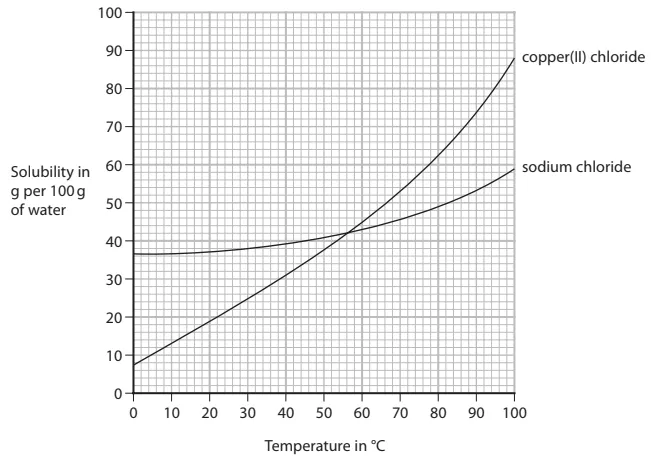
i) Determine the temperature at which copper(II) chloride and sodium chloride have the same solubility.
Show on the graph how you obtained your answer.
(2)
temperature = .............................. °C
ii) A saturated solution of copper(II) chloride in 100 g of water is cooled from 40 °C to 10 °C.
Determine the mass, in grams, of copper(II) chloride that crystallises.
(2)
mass of copper(II) chloride = .............................. g
1.2. Separate: Chemistry Only
A student uses this method to determine the solubility of potassium chloride in water at room temperature.
record the mass of an empty evaporating basin
pour some saturated potassium chloride solution into the evaporating basin
record the mass of the evaporating basin and saturated potassium chloride solution
heat the evaporating basin to remove all the water
record the mass of the evaporating basin and the dry potassium chloride
The table shows the student’s results.
Mass in grams | |
evaporating basin | 58.1 |
evaporating basin and saturated potassium chloride solution | 78.2 |
evaporating basin and dry potassium chloride | 63.2 |
i) Calculate the mass of dry potassium chloride obtained.
(1)
mass = .............................. g
ii) Calculate the mass of water removed.
(1)
mass = .............................. g
iii) Calculate the solubility of potassium chloride in grams per 100 grams of water.
(2)
solubility = .............................. g per 100 g of water
iv) Suggest why the student’s method is not suitable for determining the solubility of hydrated copper(II) sulfate.
(1)

Ai এর মাধ্যমে

১০ লক্ষ+ প্রশ্ন ডাটাবেজ

প্র্যাকটিস এর মাধ্যমে নিজেকে তৈরি করে ফেলো
উত্তর দিবে তোমার বই থেকে ও তোমার মত করে।

সারা দেশের শিক্ষার্থীদের মধ্যে নিজের অবস্থান যাচাই
No related questions found