Ionic Bonding
1. This question has 4 part(s).
1.1. The diagram shows the arrangement of electrons in an atom of calcium and in an atom of chlorine.
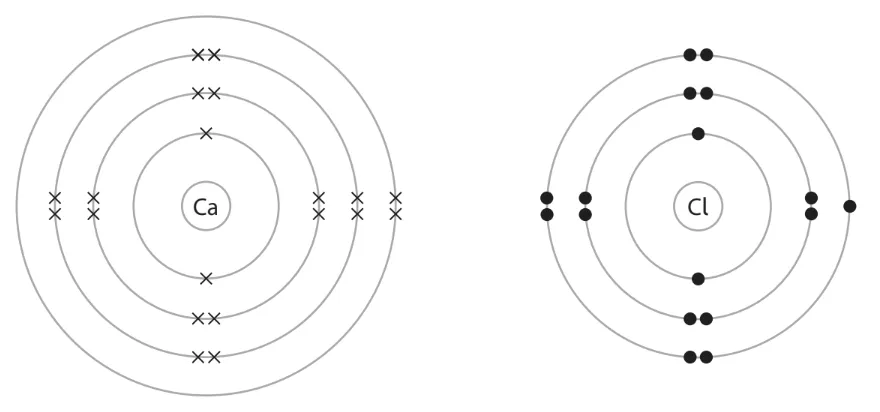
Describe, in terms of electrons, what happens when calcium reacts with chlorine to form the ionic compound calcium chloride, CaCl2
1.2. Describe tests to show that an aqueous solution of calcium chloride contains calcium ions and chloride ions.
calcium ions: ...................................................................... chloride ions: ......................................................................
1.3. Solid calcium chloride does not conduct electricity. Aqueous solutions of calcium chloride do conduct electricity. A student uses this method to investigate how the conductivity of a solution changes when calcium chloride is dissolved in pure water.
Step 1 add 100 cm3 of pure water to a beaker
Step 2 add one spatula of solid calcium chloride to the beaker Step 3 stir the solution
Step 4 measure the conductivity of the solution
Step 5 repeat until nine spatulas of solid calcium chloride have been added
The table shows the student’s results.
Number of spatulas of calcium chloride | Conductivity of solution in arbitrary units |
|---|---|
0 | 0 |
1 | 6 |
2 | 12 |
3 | 12 |
4 | 24 |
5 | 30 |
6 | 36 |
7 | 36 |
8 | 36 |
9 | 36 |
i) Plot the results on the grid and draw two straight lines of best fit. Ignore the anomalous result.
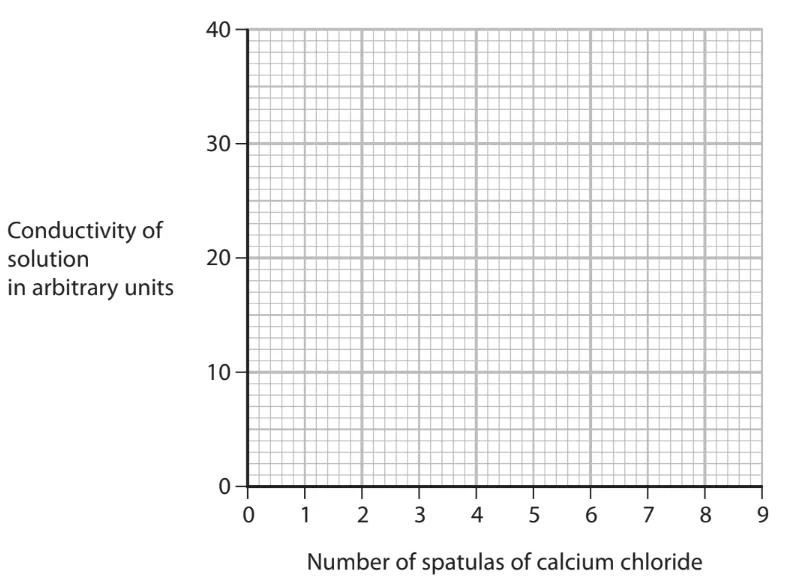
(3)
ii) State the trend shown on the graph for the first six spatulas of calcium chloride.
(1)
iii) Suggest an error the student could have made to cause the anomalous result.
(1)
1.4. Describe another way to make solid calcium chloride conduct electricity.

Ai এর মাধ্যমে

১০ লক্ষ+ প্রশ্ন ডাটাবেজ

প্র্যাকটিস এর মাধ্যমে নিজেকে তৈরি করে ফেলো
উত্তর দিবে তোমার বই থেকে ও তোমার মত করে।

সারা দেশের শিক্ষার্থীদের মধ্যে নিজের অবস্থান যাচাই
No related questions found