Selective Breeding
1. This question has 5 part(s).
1.1. The table shows some information about two types of potato plants.
Variety of potato | Size of potato | Quantity of potato | Rate of growth |
|---|---|---|---|
A | Large | Few | Slow |
B | Small | Many | Fast |
Explain how selective breeding could be used to produce potato plants which are faster growing and produce many large potatoes.
1.2. A new breeding technique has been developed which allows the production of potatoes with improved yield and quality whilst also showing a natural protection against the fungal diseases, potato blight.
Explain the benefits of breeding potato plants that are resistant to fungal diseases such as potato blight.
1.3. Scientists carried out a genetic analysis on a population of potatoes of variety A and a population of variety B potato plants to establish the proportion of heterozygous genotypes in each population.
The data in the graph gives an indication of the genetic diversity of the population where the higher the heterozygosity, the higher the genetic diversity. Conversely, fewer heterozygous genotypes (and more homozygous genotypes) means there are fewer alleles in a population and therefore genetic diversity is reduced.
The graph shows the data collected for the two varieties or potato.
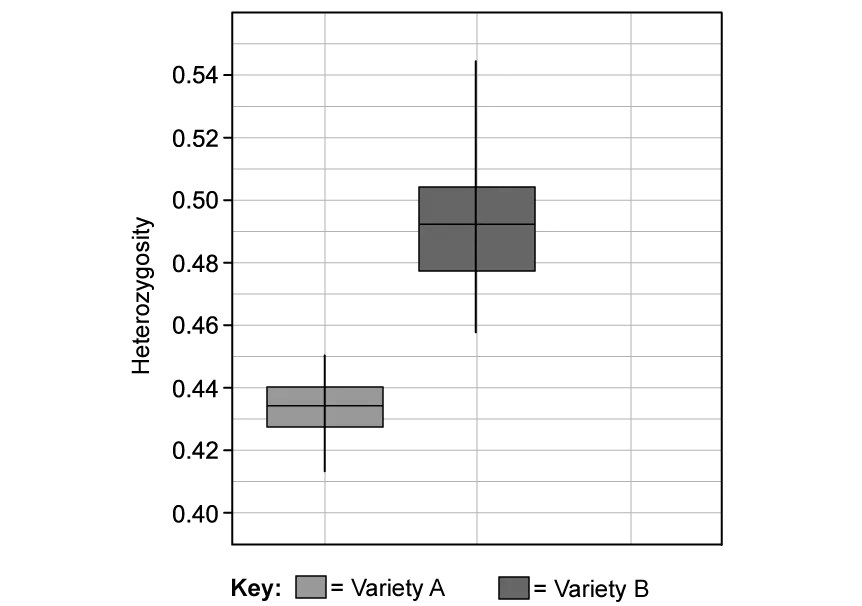
Describe what the graph shows.
1.4. Explain the issues which may be associated with a lower heterozygosity demonstrated by variety A.
1.5. Suggest how breeding together individuals from varieties A and B may reduce the effects described in (d).

Ai এর মাধ্যমে

১০ লক্ষ+ প্রশ্ন ডাটাবেজ

প্র্যাকটিস এর মাধ্যমে নিজেকে তৈরি করে ফেলো
উত্তর দিবে তোমার বই থেকে ও তোমার মত করে।

সারা দেশের শিক্ষার্থীদের মধ্যে নিজের অবস্থান যাচাই
No related questions found