4.1 Electrolysis
1. This question has 3 part(s).
1.1. Extended Only
During electrolysis, ions move in the electrolyte and electrons move in the external circuit. Reactions occur at the electrodes.
The diagram shows the electrolysis of molten lithium iodide.
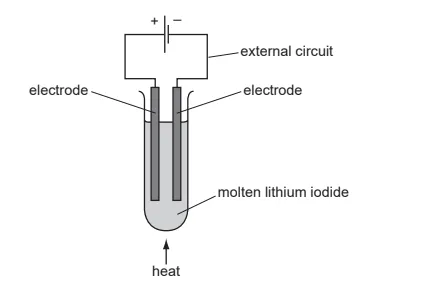
i) Draw an arrow on the diagram to show the direction of the electron flow in the external circuit.
[1]
ii) Electrons are supplied to the external circuit. How and where is this done?
[2]
iii) Explain why solid lithium iodide does not conduct electricity but when molten it is a good conductor.
[1]
1.2. The results of experiments on electrolysis are shown in the following table.
Complete the table. The first line has been done as an example.
electrolyte | electrodes | product at cathode | product at anode | change to electrolyte |
molten lithium iodide | carbon | lithium | iodine | used up |
aqueous copper (II) sulfate | platinum | oxygen | ||
concentrated aqueous potassium chloride | carbon | chlorine |
[4]
1.3. The diagram below shows the electrolysis of dilute sulfuric acid. Hydrogen is formed at the negative electrode (cathode) and oxygen at the positive electrode (anode) and the concentration of sulfuric acid increases.
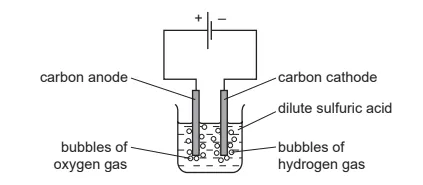
The ions present in the dilute acid are H+ (aq), OH– (aq) and SO42– (aq).
i) Write an equation for the reaction at the negative electrode (cathode).
[2]
ii) Complete the equation for the reaction at the positive electrode (anode).
4OH– (aq) → O2 (g) + .....H2O (l) + .......
[1]
iii) Suggest an explanation of why the concentration of the sulfuric acid increases.
[1]

Ai এর মাধ্যমে

১০ লক্ষ+ প্রশ্ন ডাটাবেজ

প্র্যাকটিস এর মাধ্যমে নিজেকে তৈরি করে ফেলো
উত্তর দিবে তোমার বই থেকে ও তোমার মত করে।

সারা দেশের শিক্ষার্থীদের মধ্যে নিজের অবস্থান যাচাই
No related questions found