Data Handling: Descriptive Statistics & Computation
1. This question has 2 part(s).
1.1. A psychologist wanted to see if verbal fluency is affected by whether people think they are presenting information to a small group of people or to a large group of people.
The psychologist needed a stratified sample of 20 people. She obtained the sample from a company employing 60 men and 40 women.
The participants were told that they would be placed in a booth where they would read out an article about the life of a famous author to an audience. Participants were also told that the audience would not be present, but would only be able to hear them and would not be able to interact with them.
There were two conditions in the study, Condition A and Condition B.
Condition A: 10 participants were told the audience consisted of 5 listeners.
Condition B: the other 10 participants were told the audience consisted of 100 listeners.
Each participant completed the study individually. The psychologist recorded each presentation and then counted the number of verbal errors made by each participant.
The results of the study are given in Table 1.
Table 1: Mean number of verbal errors and standard deviations for both conditions
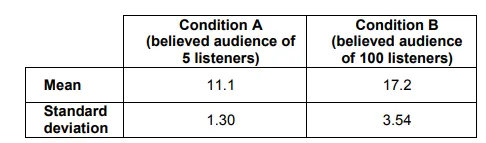
What conclusions might the psychologist draw from the data in Table 1? Refer to the means and standard deviations in your answer.
1.2. The psychologist had initially intended to use the range as a measure of dispersion in this study but found that one person in Condition A had made an exceptionally low number of verbal errors.
Explain how using the standard deviation rather than the range in this situation, would improve the study.

Ai এর মাধ্যমে

১০ লক্ষ+ প্রশ্ন ডাটাবেজ

প্র্যাকটিস এর মাধ্যমে নিজেকে তৈরি করে ফেলো
উত্তর দিবে তোমার বই থেকে ও তোমার মত করে।

সারা দেশের শিক্ষার্থীদের মধ্যে নিজের অবস্থান যাচাই
No related questions found