Reproduction
1. This question has 3 part(s).
1.1. Living organisms can reproduce via asexual reproduction or sexual reproduction.
Describe how asexual reproduction differs from sexual reproduction.
1.2. The diagram shows the structure of the human female reproductive organs.
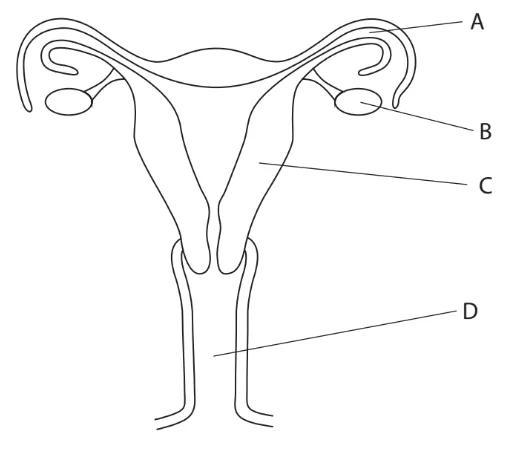
(i) What is the site of fertilisation?
(1)
☐ | A |
☐ | B |
☐ | C |
☐ | D |
(ii) Where does the fetus usually develop?
(1)
☐ | A |
☐ | B |
☐ | C |
☐ | D |
(iii) Describe the role of the hormones produced by structure B.
(4)
1.3. The male reproductive system in humans produces sperm in a liquid called semen.
The production of sperm changes with age.
A scientist investigates how age affects mean semen volume and sperm concentration in one ejaculation.
The table shows the results of the investigation.
In one ejaculation | Age in years | ||||||
|---|---|---|---|---|---|---|---|
16–30 | 31–33 | 34–36 | 37–39 | 40–43 | 44–47 | 48–72 | |
Mean semen volume in cm3 | 3.45 | 3.44 | 3.35 | 3.30 | 3.22 | 2.92 | 2.49 |
Mean sperm concentration in millions per cm3 | 61.5 | 64.2 | 64.1 | 61.1 | 62.1 | 62.4 | 56.9 |
Mean number of sperm released in millions | 212 | 221 | 215 | 202 | 182 | 142 |
(i) Calculate the mean number of sperm released in one ejaculation from men aged 40–43
(1)
(ii) Explain why mean number of sperm released is a better measure of fertility than either mean semen volume or mean sperm concentration.
(2)
(iii) Calculate the percentage decrease in mean number of sperm between men aged 37–39 and men aged 48–72
(2)

Ai এর মাধ্যমে

১০ লক্ষ+ প্রশ্ন ডাটাবেজ

প্র্যাকটিস এর মাধ্যমে নিজেকে তৈরি করে ফেলো
উত্তর দিবে তোমার বই থেকে ও তোমার মত করে।

সারা দেশের শিক্ষার্থীদের মধ্যে নিজের অবস্থান যাচাই
No related questions found