Chemical Change & Rate of Reaction
1. This question has 4 part(s).
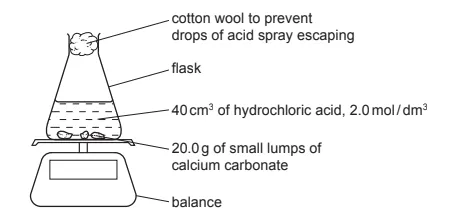
1.1. 20.0 g of small lumps of calcium carbonate and 40 cm3 of hydrochloric acid, concentration 2.0 mol / dm3, were placed in a flask on a top pan balance. The mass of the flask and contents was recorded every minute.
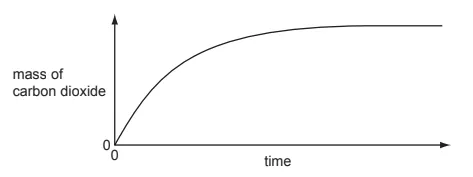
The mass of carbon dioxide given off was plotted against time.
CaCO3 (s) + 2HCl (aq) → CaCl2 (aq) + H2O (l) + CO2 (g)
In all the experiments mentioned in this question, the calcium carbonate was in excess.
i) Explain how you could determine the mass of carbon dioxide given off in the first five minutes.
[1]
ii) Explain how the shape of the graph shows where the rate is fastest, where it is slowing down and where the rate is zero.
[2]
1.2. Sketch on the same graph, the line which would have been obtained if 20.0 g of small lumps of calcium carbonate and 80 cm3 of hydrochloric acid, concentration 1.0 mol / dm3, had been used.
1.3. Extended tier only
Explain in terms of collisions between reacting particles each of the following.
i) The reaction rate would be slower if 20.0 g of larger lumps of calcium carbonate and 40 cm3 of hydrochloric acid, concentration 2.0 mol / dm3, were used.
[2]
ii) The reaction rate would be faster if the experiment was carried out at a higher temperature.
[2]
1.4. Extended tier only
Calculate the maximum mass of carbon dioxide given off when 20.0 g of small lumps of calcium carbonate react with 40 cm3 of hydrochloric acid, concentration 2.0 mol / dm3.
CaCO3 (s) + 2HCl( aq) → CaCl2 (aq) + H2O (l) + CO2 (g)

Ai এর মাধ্যমে

১০ লক্ষ+ প্রশ্ন ডাটাবেজ

প্র্যাকটিস এর মাধ্যমে নিজেকে তৈরি করে ফেলো
উত্তর দিবে তোমার বই থেকে ও তোমার মত করে।

সারা দেশের শিক্ষার্থীদের মধ্যে নিজের অবস্থান যাচাই
No related questions found