Earth & Atmospheric Science
1. This question has 5 part(s).
1.1. Air contains several gaseous elements.
Which of these shows the three most common gaseous elements in air, listed in order from the most common to the least common?
☐ | A | oxygen, chlorine, nitrogen |
☐ | B | nitrogen, oxygen, hydrogen |
☐ | C | oxygen, nitrogen, helium |
☐ | D | nitrogen, oxygen, argon |
1.2. The density of a gas can be found using the equation
A student carried out an experiment to find the density of argon.
The mass of a stopper and flask, containing no gas, was known. The flask was completely filled with argon and its mass measured.
Figure 4 shows the results the student wrote down.
mass of stopper and flask in g | 78.639 |
mass of stopper and flask full of argon in g | 79.120 |
volume of flask in cm3 | 250.0 |
Figure 4
i) Use the results to calculate the density of argon in g cm-3. (2)
density of argon = ........................................... gcm-3
ii) The flask used for the experiment is shown in Figure 5. The flask holds 250.0 cm3 when filled up to the line.
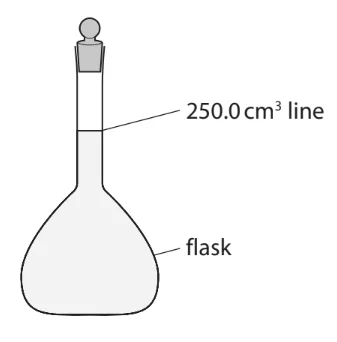
Figure 5
There is an error in the volume the student has used in the calculation. This would give an incorrect value for the density of argon.
Identify this error and state what should be done to correct it.
(2)
error.................................
what should be done to correct it ........................................
1.3. Four of the noble gases are argon, helium, krypton and neon.
Give these gases in order of increasing density.
1.4. Higher Only
Much of the carbon dioxide present in the Earth’s early atmosphere dissolved into the oceans.
This led to the formation of compounds including calcium carbonate, CaCO3.
Some of the calcium carbonate reacted with magnesium ions to form dolomite, CaMg(CO3)2.
Complete the ionic equation for the reaction of calcium carbonate with magnesium ions.
................ CaCO3 + ......................... → CaMg(CO3)2 + Ca2+ dolomite
1.5. P and Q are both mixtures of gases. One has the same composition as the early atmosphere and the other has the same composition as the current atmosphere.
Tests are carried out on gas mixtures P and Q.
The test for carbon dioxide is to bubble the gas into limewater; if carbon dioxide is present calcium carbonate is formed.
The results of the tests are shown in Figure 6.
test | result with gas mixture P | result with gas mixture Q |
bubble gas into limewater | white precipitate forms after 4 minutes | white precipitate forms after 10 seconds |
place burning splint into gas mixture | splint continues to burn | splint immediately goes out |
Figure 6
Explain, using the data in Figure 6, which gas mixture represents the early atmosphere.

Ai এর মাধ্যমে

১০ লক্ষ+ প্রশ্ন ডাটাবেজ

প্র্যাকটিস এর মাধ্যমে নিজেকে তৈরি করে ফেলো
উত্তর দিবে তোমার বই থেকে ও তোমার মত করে।

সারা দেশের শিক্ষার্থীদের মধ্যে নিজের অবস্থান যাচাই
No related questions found