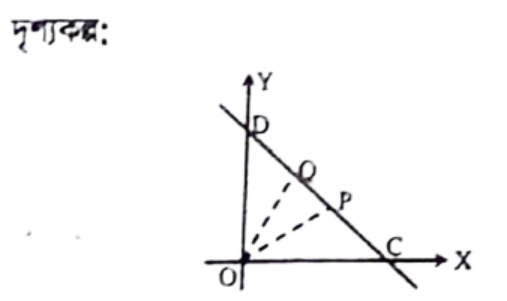
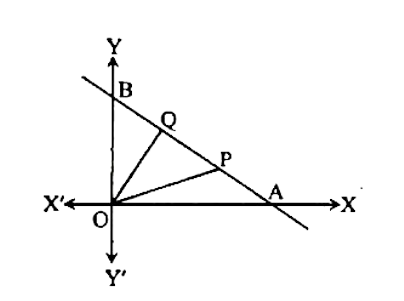
Find the area of the triangle formed by the lines y−x=0, x+y=0 and x−k=0.
হানি নাটস
Simplification of given data.
The equation of the given lines are
y−x=0…(1)x+y=0…(2)x−k=0…(3)
The point of intersection of lines (1) and (2):
From (1), y=x
Putting it in (2), x+x=0⇒x=0
Putting it in (1), y=0
So, point of intersection is (0,0)
The point of intersection of lines (2) and (3):
From (3), x=k
Putting it in (1), y−k=0⇒y=k
So, point of intersection is (k,k)
Thus, the vertices of the triangle formed by the three given lines are (0,0),(k,−k), and (k,k).
Area of triangle
We know that area of triangle whose vertices are (x1,y1),(x2,y2) and (x3,y3) is
=21∣x1(y2−y3)+x2(y3−y1)+x3(y1−y2)∣
Area of triangle △OAB whose vertices are O(O,O),A(k,k) and B(k,−k)
=21∣O(k−(−k))+k(−k−0)+k(O−k)∣=21∣O+k(−k)+k(−k)∣=21−k2−k2=21−2k2=22k2=k2 square units.
Final answer:
Therefore, required area of triangle is k2 square units.