Reactions of Ions in Aqueous Solution
1. This question has 4 part(s).
1.1. Aqueous iron (II) ions are reacted separately with aqueous ammonia solution and aqueous sodium carbonate solution.
Using equations describe the observations that would be associated with each of the reactions.
1.2. A range of complexes are given in the table below.
Table 1
W | X | Y | Z |
[Cu(H2O)6]2+ | [Al(H2O)6]3+ | [Fe(H2O)6]2+ | [Cu(NH3)4(H2O)6]2+ |
Use the information in the table to answer the following questions.
i) What is observed when aqueous sodium hydroxide solution is added to complex X.
ii) State which complexes are blue.
iii) What is observed when aqueous ammonia solution is added to complex Y.
iv) What is observed when aqueous sodium carbonate solution is added to complex W.
1.3. The transition metals ion solutions have some similarities with how they will react to form different complexes. Figure 1 shows a series of reactions which aqueous nickel (II) ions undergo.
Figure 1
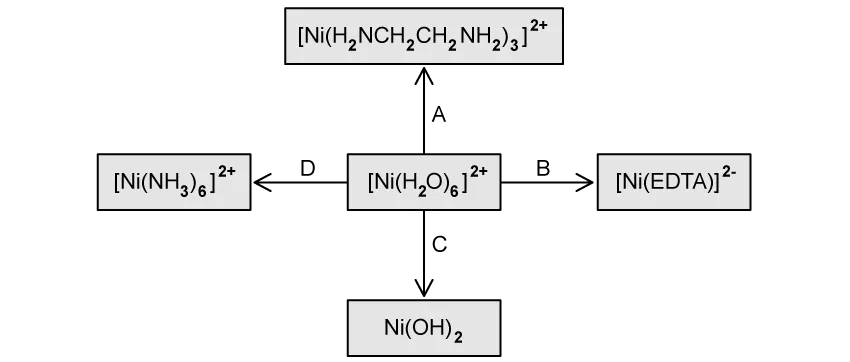
Using your knowledge of the transition metal ions and their solutions answer the following questions.
i) State the coordination number of the complex [Ni(edta)]2-.
ii) State the oxidation state of nickel in [Ni(H2NCH2CH2NH2)3]2+.
iii) Name the reagent that would cause reaction A.
iv) State the shape of the [Ni(NH3)6]2+ complex.
1.4. When solutions of aqueous iron (II) and aqueous iron (III) ions are individually reacted with aqueous sodium carbonate, different reactions occur. Using equations and relative acidity explain the difference in the reactions.

Ai এর মাধ্যমে

১০ লক্ষ+ প্রশ্ন ডাটাবেজ

প্র্যাকটিস এর মাধ্যমে নিজেকে তৈরি করে ফেলো
উত্তর দিবে তোমার বই থেকে ও তোমার মত করে।

সারা দেশের শিক্ষার্থীদের মধ্যে নিজের অবস্থান যাচাই
No related questions found