9. Gas Exchange
1. This question has 4 part(s).
1.1. Fig 1. shows an alveolus and a neighbouring capillary.
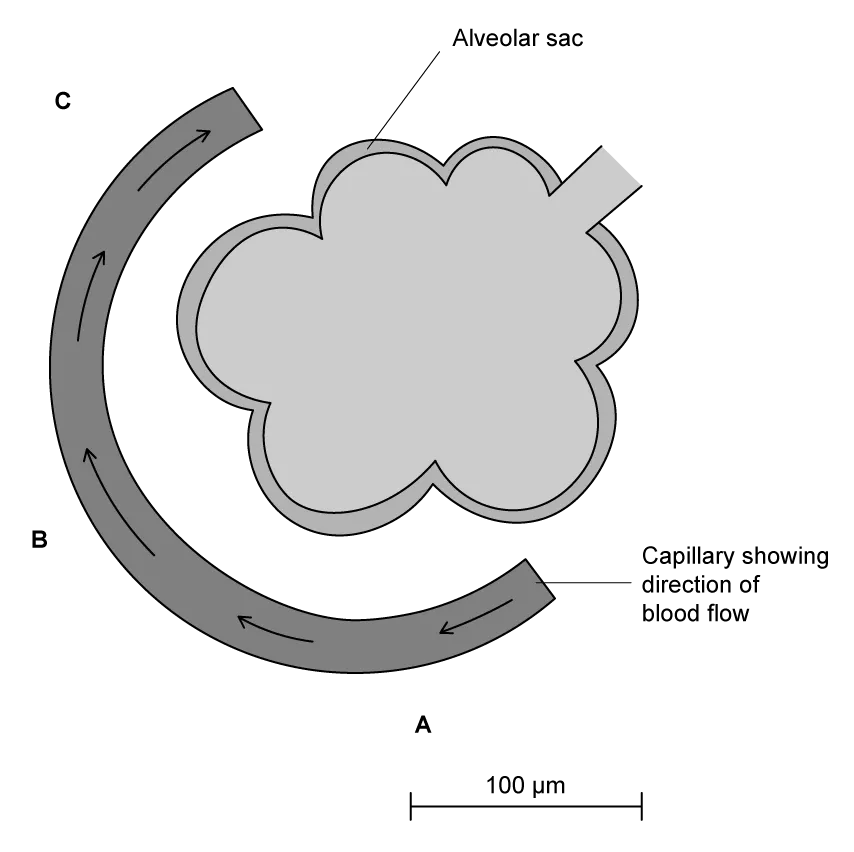
Fig. 1
Using the terms 'high', 'medium' and 'low', complete the table to show the relative blood concentrations of the substances indicated at the points A, B and C shown in Fig. 1
A | B | C | |
Oxygen | |||
Haemoglobin/oxyhaemoglobin | |||
Carbon dioxide |
1.2. Each alveolus allows the passage of 6 × 10⁻³ mm3 of blood per minute when a healthy person is at rest.
This person has 450 million alveoli per lung.
Calculate the flow rate of blood through the lungs of this person.
State your answer in standard form using the units mm3min-1.
1.3. Starting with the innermost layer and travelling outwards, place the following tissues/structures into the order that they are found in a human trachea.
Cartilage
Tracheal wall
Connective tissue
Lumen
Ciliated epithelium with glands
1.4. C-shaped rings of cartilage strengthen the trachea along its length. These are C-shaped to allow the trachea to narrow under certain circumstances. The trachea runs alongside the oesophagus for much of its length.
Suggest why the trachea has to become narrower on occasions.

Ai এর মাধ্যমে

১০ লক্ষ+ প্রশ্ন ডাটাবেজ

প্র্যাকটিস এর মাধ্যমে নিজেকে তৈরি করে ফেলো
উত্তর দিবে তোমার বই থেকে ও তোমার মত করে।

সারা দেশের শিক্ষার্থীদের মধ্যে নিজের অবস্থান যাচাই
No related questions found