Density & Pressure
1. This question has 4 part(s).
1.1. The Galileo thermometer was invented in the 17th century and it is still popular today. The thermometer consists of a column of liquid containing roughly spherical, weighted, glass bulbs, as shown in Fig. 1.1.
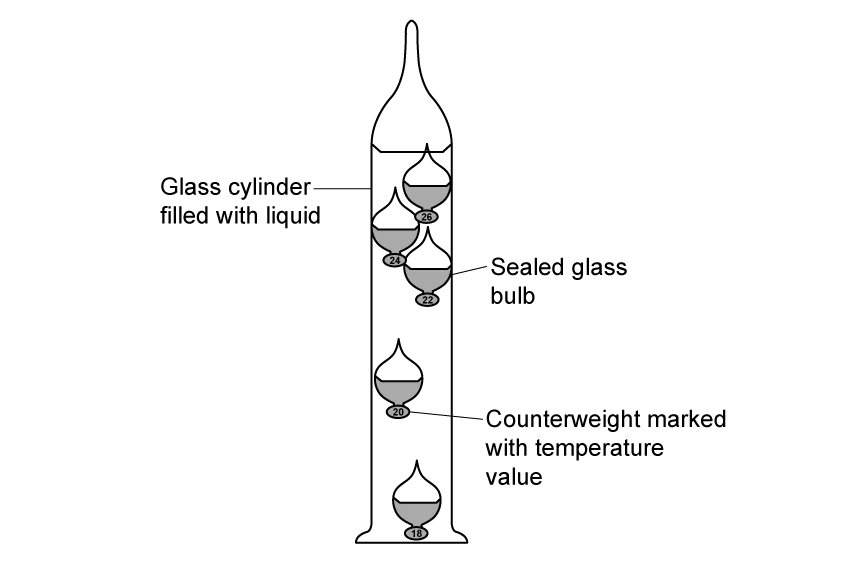
Fig. 1.1
The spheres move up or down in the column as the temperature changes.
At a certain temperature, one of the spheres begins to fall through the liquid at an increasing speed.
(i) State the property of the liquid that causes the spheres to move up or down as the temperature changes.
[1]
(ii) The sphere has a radius of 1.2 cm and once settled, it displaces a total mass of 7.3 g of the liquid.
Calculate the value of the property of the liquid named in (a)(i).
[3]
1.2. Sketch arrows on Fig. 1.2 to show the relative sizes of the forces acting on the sphere as it falls.

Fig. 1.2
1.3. Show that the upthrust on the sphere is about 0.07 N.
1.4. The spheres in the column are identical but have different masses due to the counterweight attached to them.
State and explain where you would expect to find a sphere of weight 0.069 N.

Ai এর মাধ্যমে

১০ লক্ষ+ প্রশ্ন ডাটাবেজ

প্র্যাকটিস এর মাধ্যমে নিজেকে তৈরি করে ফেলো
উত্তর দিবে তোমার বই থেকে ও তোমার মত করে।

সারা দেশের শিক্ষার্থীদের মধ্যে নিজের অবস্থান যাচাই
No related questions found