Wave Behaviour
1. This question has 3 part(s).
1.1. Fig. 20.1 is a graph of a wave.
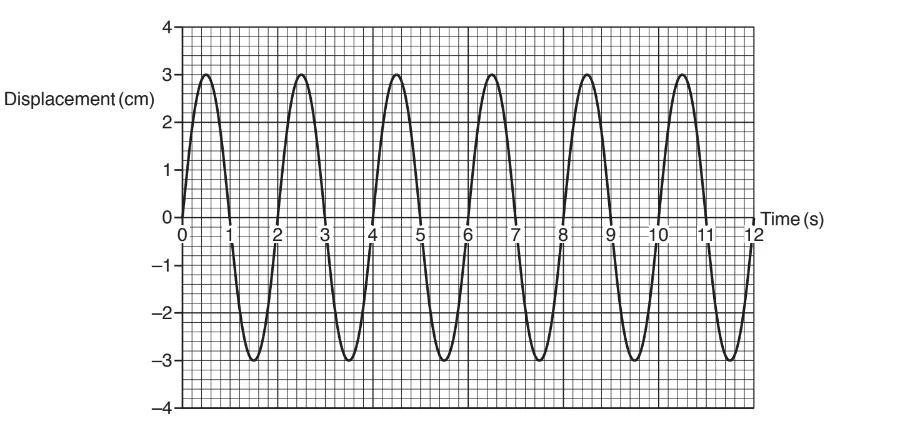
Fig. 20.1
i) Use the graph in Fig. 20.1 to work out the time period of the wave.
Time period of the wave = ................................ s [1]
ii) Use the graph in Fig. 20.1 to work out the amplitude of the wave.
Amplitude = ................................ cm [1]
iii) The frequency of the wave in Fig. 20.1 is 0.5 Hz.
What is meant by the term frequency?
[1]
1.2. A water wave has a frequency of 0.25 Hz and a wavelength of 6.0 m.
Calculate the speed of the wave.
Speed of the wave = ................................ m/ s
1.3. Surface water waves can be modelled using a slinky spring.
A student holds one end of the spring on a table. The other end is fixed to a wall.
Fig. 20.2 shows the spring viewed from above the table.

Fig. 20.2
i) Draw two arrows on the diagram in Fig. 20.2 to show the movement of the student’s hand when he makes a transverse wave.
[1]
ii) Describe what happens to the transverse wave at the wall.
[1]
iii) In Fig. 20.3 the student stops moving his hand.
This is what the coils in the spring look like after a short time:
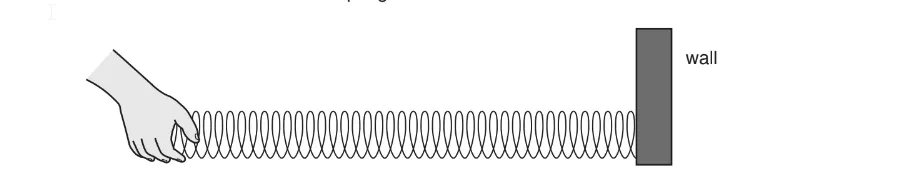
Fig. 20.3
This model of a water wave shows that the wave travels not the water.
Explain why.
[1]

Ai এর মাধ্যমে

১০ লক্ষ+ প্রশ্ন ডাটাবেজ

প্র্যাকটিস এর মাধ্যমে নিজেকে তৈরি করে ফেলো
উত্তর দিবে তোমার বই থেকে ও তোমার মত করে।

সারা দেশের শিক্ষার্থীদের মধ্যে নিজের অবস্থান যাচাই
No related questions found