Electrolytic Processes
1. This question has 4 part(s).
1.1. An electrolysis experiment is carried out on different solutions, J, K and L.
Electricity is passed through each solution as shown in Figure 3.
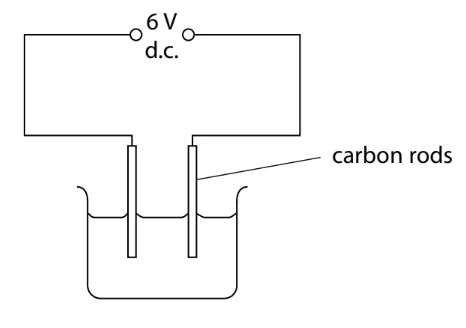
Figure 3
Any products formed at the electrodes are identified.
The results are given in Figure 4.
solution | solution conducts electricity | product at cathode | product at anode |
J | yes | copper | chlorine |
K | no | none | none |
L | yes | hydrogen | chlorine |
Figure 4
i) State an improvement that can be made to the circuit to show that a current is flowing during the electrolysis.
(1)
Some of these solutions are electrolytes.
ii) State what is meant by the term electrolyte.
(2)
iii) Which of J, K and L are electrolytes?
(1)
☐ | A | K only |
☐ | B | J and L only |
☐ | C | K and L only |
☐ | D | J, K and L |
1.2. Copper sulfate solution was electrolysed for five minutes using copper electrodes.
Figure 5 shows the mass of the anode and of the cathode before electrolysis and after electrolysis.
anode | cathode | |
mass of electrode | 1.16 | 1.28 |
mass of electrode | 0.85 | 1.57 |
Figure 5
Calculate the mass of copper deposited.
mass of copper deposited = ............................................................... g
1.3. Identify the products formed at the anode and cathode when molten potassium iodide is electrolysed.
Anode ...................................
Cathode ................................
1.4. In a different electrolysis, molten sodium fluoride is decomposed.
2NaF → 2Na + F2
(relative atomic masses: F = 19, Na = 23)
(relative formula mass NaF = 42)
Calculate the maximum mass of sodium that could be formed from 168g of sodium fluoride.

Ai এর মাধ্যমে

১০ লক্ষ+ প্রশ্ন ডাটাবেজ

প্র্যাকটিস এর মাধ্যমে নিজেকে তৈরি করে ফেলো
উত্তর দিবে তোমার বই থেকে ও তোমার মত করে।

সারা দেশের শিক্ষার্থীদের মধ্যে নিজের অবস্থান যাচাই
No related questions found