Cell Membranes & Transport
1. This question has 4 part(s).
1.1. Complete Table 1 by placing a tick ( ✔ ) in the appropriate boxes.
Table 1
Simple diffusion | Osmosis | Facilitated diffusion | Active Transport | |
Movement of glucose from high to low concentration | ||||
Movement down a concentration gradient | ||||
Movement of water from high water potential to low water potential. | ||||
Movement of oxygen from the plasma into a red blood cell |
1.2. Figure 1 shows a molecule (X) that is about to be transported across a cell membrane.
Figure 1
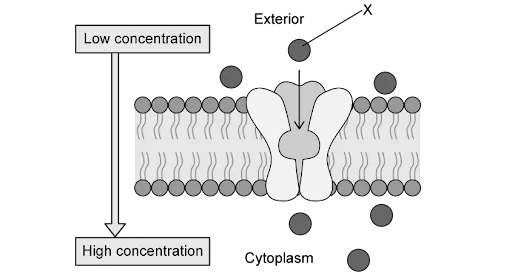
Describe the events that would take place in order for molecule X in Figure 1 to move from the exterior of the cell into the cytoplasm.
1.3. Figure 2 below shows the absorption of certain nutrients from the lumen of the small intestine into the blood.
Figure 2
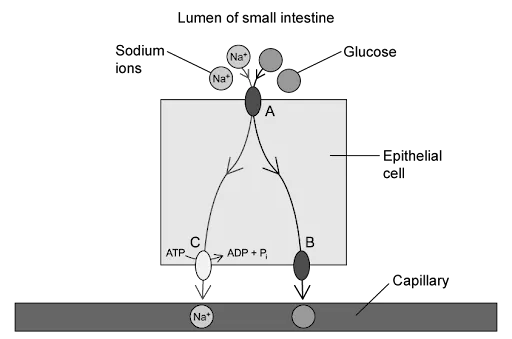
Name the membrane transport processes taking place at A and B in Figure 2.
1.4. State the purpose of the process taking place at the position labelled C in Figure 2.

Ai এর মাধ্যমে

১০ লক্ষ+ প্রশ্ন ডাটাবেজ

প্র্যাকটিস এর মাধ্যমে নিজেকে তৈরি করে ফেলো
উত্তর দিবে তোমার বই থেকে ও তোমার মত করে।

সারা দেশের শিক্ষার্থীদের মধ্যে নিজের অবস্থান যাচাই
This question has 4 part(s).
Researchers have discovered that an individual phospholipid molecule can exchange places with its neighbouring phospholipid molecule in a monolayer as frequently as 107 times per second. By contrast, phospholipid molecules almost never exchange places with each other from one monolayer to the other within a bilayer, referred to as a ‘flip-flop’ exchange. The ‘flip-flop' takes place around once a month for a typical phospholipid molecule.
Use your knowledge of membrane structure to explain this difference in molecular behaviour.
This question has 4 part(s).
This question has 4 part(s).