Rate of Reaction
1. This question has 4 part(s).
1.1. A student investigated the effect of the size of calcium carbonate lumps, CaCO3, on the rate of reaction with hydrochloric acid, HCl, using the following method:
Put 50 cm3 of hydrochloric acid into a conical flask
Add 12 g of large calcium carbonate lumps into the flask
Attach the gas syringe
Measure the volume of gas produced every 30 seconds for 180 seconds
Repeat steps 1 - 4 using 12 g of small calcium carbonate lumps.
The number of moles of gas for each volume was calculated.
The results for large calcium carbonate lumps are shown below.
Table 1.
Time in seconds | Number of moles of gas |
0 | 0.000 |
30 | 0.0012 |
60 | 0.0022 |
90 | 0.0030 |
120 | 0.0034 |
150 | 0.0037 |
180 | 0.0038 |
The student had already plotted the data for small calcium carbonate lumps.
Plot the data for the large calcium carbonate lumps and draw a line of best fit.
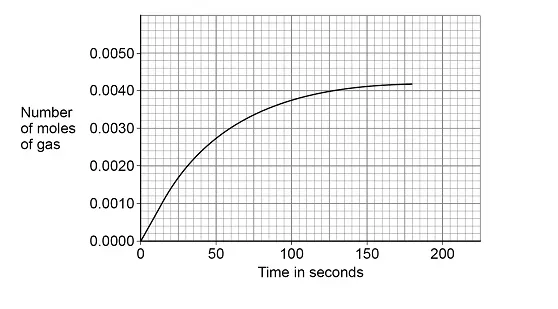
1.2. Determine the mean rate of reaction for small calcium carbonate lumps between 35 seconds and 90 seconds.
Give the unit.
Use the graph in part (a).
1.3. What conclusion can be made about the rate of reaction of small calcium carbonate lumps compared to large calcium carbonate lumps?
Give one reason for your answer.
1.4. Complete and balance the equation for the reaction between calcium carbonate and hydrochloric acid.
__________ + __________ → CaCl2 + __________ + __________

Ai এর মাধ্যমে

১০ লক্ষ+ প্রশ্ন ডাটাবেজ

প্র্যাকটিস এর মাধ্যমে নিজেকে তৈরি করে ফেলো
উত্তর দিবে তোমার বই থেকে ও তোমার মত করে।

সারা দেশের শিক্ষার্থীদের মধ্যে নিজের অবস্থান যাচাই
No related questions found