Predicting Chemical Reactions
1. This question has 3 part(s).
1.1. This question is about elements in the Periodic Table.
Look at the table. It shows some properties of Group 7 elements.
Element | Molecular formula | State at room temperature | Radius of an atom (nm) | Order of reactivity |
Fluorine | F2 | ......................... | 0.072 | most reactive least reactive |
Chlorine | Cl2 | gas | 0.099 | |
Bromine | Br2 | liquid | 0.114 | |
Iodine | I2 | solid | 0.133 | |
Astatine | At2 | solid | ........................ |
Complete the table. Use ideas about trends down a Group to help you.
1.2. In the table, the Group 7 elements are listed in order of reactivity.
The equations show a displacement reaction of Group 7 elements.
chlorine + sodium bromide → sodium chloride + bromine
Cl2 + 2NaBr → 2NaCl + Br2
i) Complete the word equation.
bromine + sodium iodide → ................... + ...................
[1]
ii) There is no reaction between iodine and sodium bromide.
Explain why.
[1]
iii) Chlorine reacts with sodium iodide. Sodium chloride and iodine are made.
Write the balanced symbol equation for this reaction.
[2]
1.3. Group 1 is another group of elements in the Periodic Table.
i) Potassium is a Group 1 metal.
Potassium is stored under oil because it is very reactive.
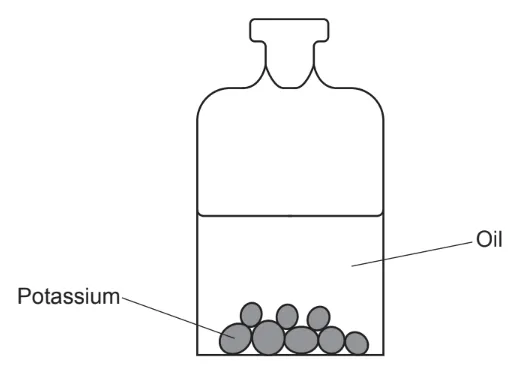
What does the oil stop the potassium reacting with?
[1]
ii) Sodium is another Group 1 metal.
Sodium reacts in a similar way to potassium.
Explain why.
Use ideas about atomic structure in your answer.
[1]

Ai এর মাধ্যমে

১০ লক্ষ+ প্রশ্ন ডাটাবেজ

প্র্যাকটিস এর মাধ্যমে নিজেকে তৈরি করে ফেলো
উত্তর দিবে তোমার বই থেকে ও তোমার মত করে।

সারা দেশের শিক্ষার্থীদের মধ্যে নিজের অবস্থান যাচাই
No related questions found