Organic Chemistry II: Carboxylic Acids
1. This question has 2 part(s).
1.1. Ethyl ethanoate is an ester.

One method for the formation of ethyl ethanoate is the reaction between ethanoland ethanoic acid, which is catalysed by hydrogen ions.
CH3COOH + C2H5OH ⇌ CH3COOC2H5 + H2O
An incomplete simplified mechanism for this reaction is shown.
i) Add curly arrows and relevant lone pairs of electrons to complete the mechanism.
(4)
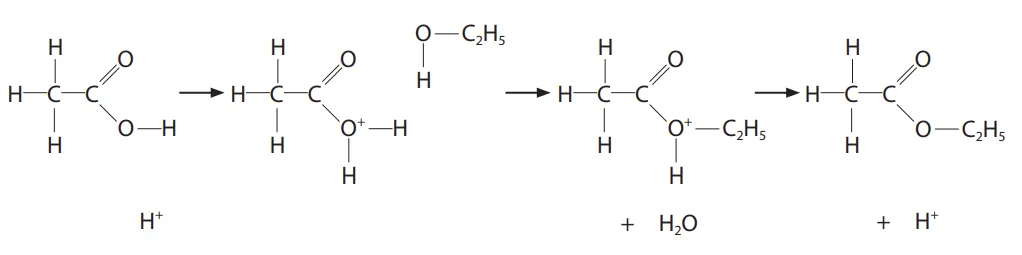
ii) In an experiment, the oxygen atom in ethanol is replaced by the oxygen-18 isotope, 18O. The products of the esterification are

Label the 18O oxygen atom in one of the products.
Justify your answer.
(2)
iii) Calculate the standard molar entropy of ethyl ethanoate using your knowledge of Gibbs free energy, ∆G, and the data in the table.
Include sign and units in your answer.
Use ∆G = −RT ln K and other appropriate equations.
Quantity | Value |
Gas constant, R | 8.31 J mol−1 K−1 |
Temperature, T | 298 K |
Equilibrium constant of esterification reaction, K | 4.0 |
Enthalpy change of esterification reaction, ∆H | −6.0 kJ mol−1 |
Standard molar entropy of ethanoic acid, SO | 159.8 J K−1 mol−1 |
Standard molar entropy of ethanol, SO | 160.7 J K−1 mol−1 |
Standard molar entropy of water, SO | 69.9 J K−1mol−1 |
(6)
1.2. Ethyl ethanoate can also be formed by reacting ethanol with ethanoyl chloride, CH3COCl.
Identify three differences in the esterification reaction when ethanoyl chloride is used instead of ethanoic acid.

Ai এর মাধ্যমে

১০ লক্ষ+ প্রশ্ন ডাটাবেজ

প্র্যাকটিস এর মাধ্যমে নিজেকে তৈরি করে ফেলো
উত্তর দিবে তোমার বই থেকে ও তোমার মত করে।

সারা দেশের শিক্ষার্থীদের মধ্যে নিজের অবস্থান যাচাই
No related questions found