19.1 Energy Flow
1. This question has 5 part(s).
1.1. The dominant grass species in an African grassland ecosystem are star grass and red oat grass.
Star grass is eaten by antelope species, such as topi and Thomson’s gazelle.
Smaller animals such as mice and grasshoppers feed on red oat grass.
Topi and Thomson’s gazelle are eaten by predators such as cheetahs, lions and serval cats.
Grasshoppers and mice are eaten by serval cats and tawny eagles.
Vultures feed on dead mammals.
Fig. 1 shows part of the food web for this ecosystem.
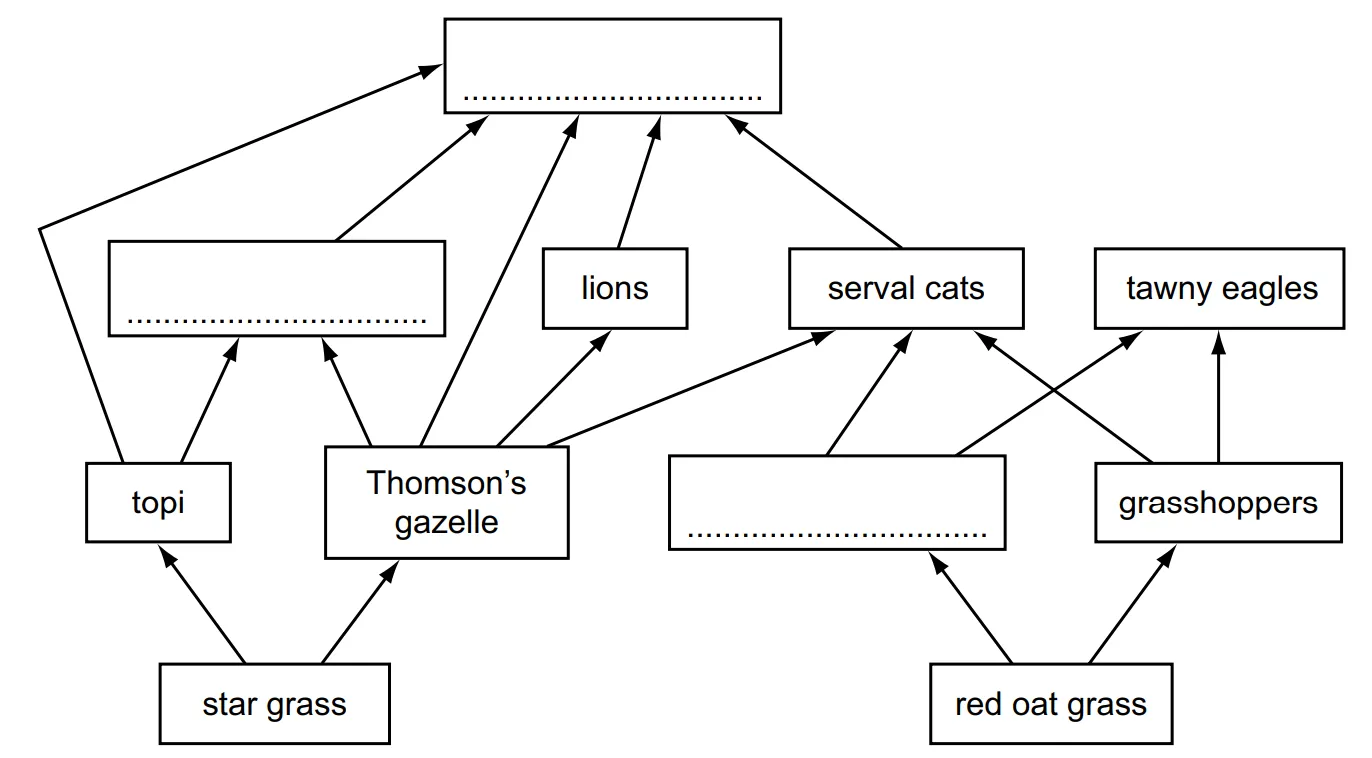
Fig. 1
Complete the food web by writing the names of the correct organisms in the boxes in Fig. 1.
1.2. Name the trophic level of the following species.
(i) Star grass
[1]
(ii) Topi
[1]
1.3. (i) State the principal source of energy for the food web shown in Fig. 1.
[1]
(ii) State what happens to energy when it leaves a food web.
[1]
1.4. Explain why there are no more than four trophic levels in the food web shown in Fig. 1.
1.5. Extended only
Fish such as salmon can be reared intensively in fish farms. They are fed on high protein food made from animals. When eating this food, the fish are feeding as secondary consumers.
Describe the disadvantages of intensive farming, such as salmon farming, for producing human food.

Ai এর মাধ্যমে

১০ লক্ষ+ প্রশ্ন ডাটাবেজ

প্র্যাকটিস এর মাধ্যমে নিজেকে তৈরি করে ফেলো
উত্তর দিবে তোমার বই থেকে ও তোমার মত করে।

সারা দেশের শিক্ষার্থীদের মধ্যে নিজের অবস্থান যাচাই
No related questions found