Genetic Modification (Genetic Engineering)
1. This question has 4 part(s).
1.1. As part of a global scientific push to improve the efficiency and sustainability of agriculture, scientists have developed a transgenic pig. The process used to create the transgenic pig, known as 'Enviropig', is summarised below.
Genes are taken from E. coli bacteria and also from mice.
The combined E. coli and mouse genes are inserted into a fertilised pig egg cell nucleus using a microscope and a very small, sharp, pipette.
The newly modified egg cell divides and develops into an embryo.
The embryo is implanted into the uterus of a surrogate pig and allowed to develop to maturity.
The resulting piglet is a transgenic 'Enviropig' that is able to produce E. coli and mouse proteins.
(i) Explain why a plasmid vector is not a suitable way of inserting the desired genes into the fertilised pig egg cell in step 2.
(2)
(ii) Explain why all of the cells in the pig embryo that develops in step 3 contain the new genes.
(2)
Separate: Biology only
(iii) Use your knowledge of the role of DNA to explain why the piglet in step 5 is able to produce E. coli and mouse proteins.
(2)
1.2. The genes inserted into the genome of 'Enviropig' allow pigs to produce an enzyme called phytase in their saliva. Phytase enables the pigs to digest phosphorus, a mineral that is required in the diet of pigs, but that would otherwise be egested by pigs in their faeces.
Pigs that are unable to produce their own phytase need to take phytase supplements in their food, and still egest a large amount of phosphorus in their waste.
Note that phosphorus is a mineral often found in industrial fertilisers.
Use the information provided and your own knowledge to discuss the potential benefits of 'Enviropig'.
1.3. The graph below shows the phosporus levels in the faeces of pigs with different percentages of soybean meal in their diet.
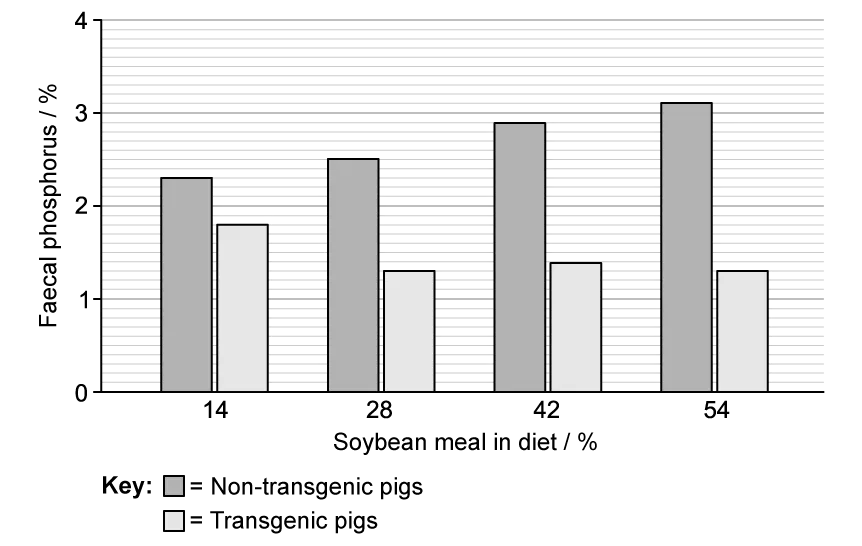
(i) Calculate the percentage decrease in faecal phosphorus between non-transgenic and transgenic pigs on a diet of 54 % soybean meal.
(2)
(ii) Describe what the results show about the impact of the addition of the new genes on faecal phosphorus in pigs. Avoid repeating any data points used in part (i).
(3)
1.4. An environmental science student read the results of the study shown in part (c) and reached the following conclusion:
"In the future, 'Enviropigs' will provide a solution to the sustainability issues around pig farming worldwide"
Evaluate the student's conclusion.

Ai এর মাধ্যমে

১০ লক্ষ+ প্রশ্ন ডাটাবেজ

প্র্যাকটিস এর মাধ্যমে নিজেকে তৈরি করে ফেলো
উত্তর দিবে তোমার বই থেকে ও তোমার মত করে।

সারা দেশের শিক্ষার্থীদের মধ্যে নিজের অবস্থান যাচাই
No related questions found