Brønsted–Lowry Theory of Acids & Bases
1. This question has 4 part(s).
1.1. i) State what is meant by a Brønsted–Lowry base.
[1]
ii) Explain what is meant by a weak acid.
[2]
1.2. A student titrated 0.10 mol dm-3 acid into a conical flask containing 25.0 cm3 of 0.10 mol dm-3 of a base, recording the pH with each addition of acid. The student repeated the procedure using different combinations of acids and bases.
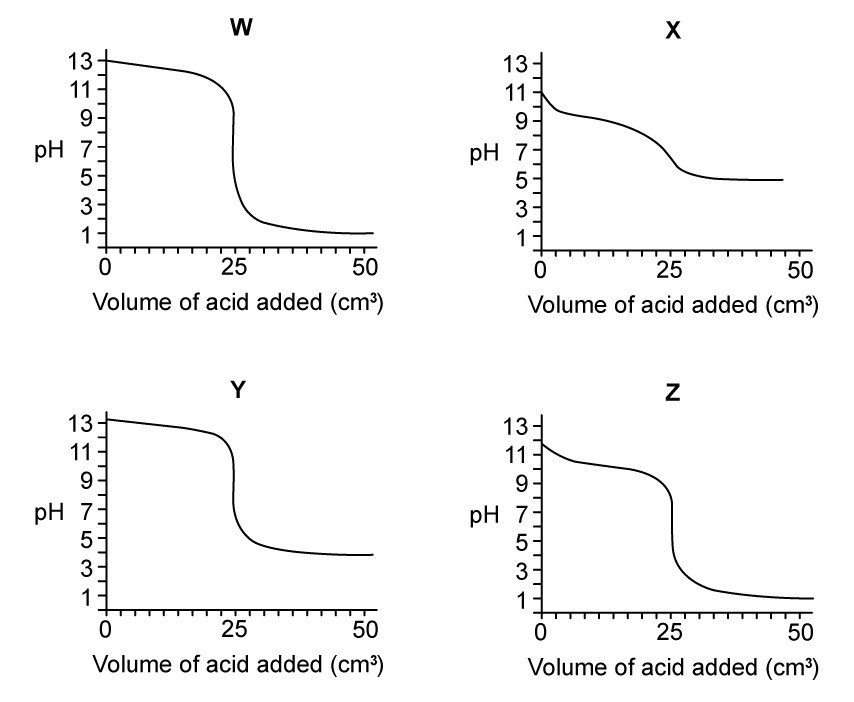
Fig. 5.1
Identify the curve in Fig. 5.1 that represents the titration of:
i) Ammonia and ethanoic acid.
[1]
ii) Ammonia and nitric acid.
[1]
iii) Sodium hydroxide and propanoic acid.
[1]
1.3. Identify which indicator in Table 5.2 would be most suitable for curve Z. Explain your answer.
Table 5.2
Indicator | pH range |
|---|---|
Methyl orange | 3.1–4.4 |
Phenolphthalein | 8.3–10.0 |
Bromothymol blue | 6.0–7.6 |
1.4. Water is amphoteric and will react with nitric acid and ammonia.
i) Construct an equation to show how water reacts with ammonia.
[1]
ii) State what is meant by the term amphoteric.
[1]

Ai এর মাধ্যমে

১০ লক্ষ+ প্রশ্ন ডাটাবেজ

প্র্যাকটিস এর মাধ্যমে নিজেকে তৈরি করে ফেলো
উত্তর দিবে তোমার বই থেকে ও তোমার মত করে।

সারা দেশের শিক্ষার্থীদের মধ্যে নিজের অবস্থান যাচাই
No related questions found