Energetics II: Born-Haber
1. This question has 3 part(s).
1.1. This question is about ions and ionic compounds.
The first three ionisation energies of calcium are shown in the table.
| Second ionisation | Third ionisation | |
Ionisation energy / kJ mol−1 | 590 | 1145 | 4912 |
Orbital |
i) Complete the table by identifying the specific orbital from which each electron is removed.
(2)
ii) Write the equation for the third ionisation energy of calcium. Include state symbols.
(1)
iii) Explain why the difference between the second and third ionisation energies of calcium is much larger than the difference between the first and second ionisation energies.
(2)
1.2. The diagram, which is not drawn to scale, shows the Born-Haber cycle for lithium fluoride. The energy changes are given in kJ mol−1.
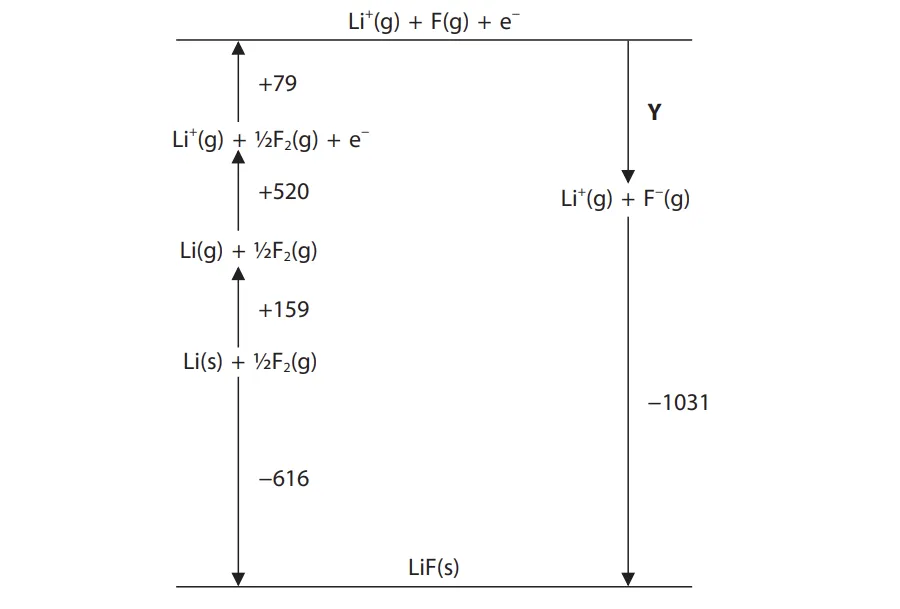
What is the value for Y, in kJ mol−1?
1.3. The table shows the theoretical and experimental lattice energy values of two compounds.
Compound | Theoretical lattice energy / kJ mol−1 | Experimental lattice energy / kJ mol−1 |
lithium chloride, LiCl | −845 | −848 |
magnesium iodide, MgI2 | −1944 | −2327 |
Comment on the theoretical and experimental lattice energy values, giving the reasons for any differences and similarities.

Ai এর মাধ্যমে

১০ লক্ষ+ প্রশ্ন ডাটাবেজ

প্র্যাকটিস এর মাধ্যমে নিজেকে তৈরি করে ফেলো
উত্তর দিবে তোমার বই থেকে ও তোমার মত করে।

সারা দেশের শিক্ষার্থীদের মধ্যে নিজের অবস্থান যাচাই
No related questions found